Saturday, July 21, 2012

Tomato vinaigrette

I'm working on two posts that require a lot of research and time, so meanwhile, here's how to make the easiest and most delicious dressing I've ever had :) Well, if you have a food processor. I used to be food processorless and I dreamt of making things like this. It's a really good investment. Anyway, onto the tomato vinaigrette!

Things you'll need

2 small, heirloom tomatoes. So pretty!

Left: Purple cherokee grown by my boyfriend. Right: Heirloom variety grown by farmer with the beard  at the Triangle farmers market

1/4 cup white wine vinegar
1/4 cup olive oil
Pinch of salt (optional)
Black pepper (optional)
Small garlic clove (optional)
Dried oregano or basil (optional)
A small pot of boiling water and a bowl of ice water

Directions:

Rinse the tomato and then cut out the core.


Cut an X on the top where you cut the core out (this just gives you easy edges to peel the skin off later).


Boil a small pot of water. Once it's rolling, drop the tomatoes in (top down is best) for 12 seconds. I use tongs. Take them out and put them in a bowl of ice water for about a minute, or until you can handle them. They shouldn't have gotten very hot anyway.

Peel the skin off with yo' fingas.

Roughly chop and put in the food processor. This time I tried adding some fresh basil. It's all good. Put in about 1/4 cup of white wine vinegar and the salt, if you like. Sometimes I forego the salt entirely. You can also put in black pepper and a chopped garlic clove.

Puree for 20 seconds or so. It doesn't take long!

Pour mixture into an old salad dressing bottle and then add about 1/4 cup of olive oil. DON'T use coconut oil, or your dressing will become hard and will take an hour to "thaw". Olive oil may harden a bit in the fridge as well (but not to the extent that coconut oil does).

(I add the oil after processing it, because then it's a cinch to rinse all the pieces of my food processor!)

Put the top on and mix it up, then taste it. Add more oil, vinegar, or salt as necessary. It should distinctly taste like tomatoes and vinegar. So good :)

Enjoy!

Monday, July 9, 2012

Schrödinger's sweet potato

This post's title is thanks to the brilliance of my friend, Peter.

My sweet potato plants have been, by far, the happiest thing in my new garden. Well, the lemongrass is also kicking butt. But anyway, the vines are beautiful, green, uniform, disease-free, and spilling over the bed. Some bugs have chowed down but not to any alarming degree. Plus, if nothing wants to eat my stuff, why should I?

I had read something mentioning I should trim the vines if they spill out of their contained bed...but I was like...huh, why? No explanation was given, so I ignored it.

Then my boyfriend was reading about growing sweet potatoes and said that if they are overly fertile, they won't produce tubers...just leaves. The tuber is a storage structure for when it's cold or the plant isn't getting enough water, so if its conditions are too good, there may not be a need to produce a tuber. Weird, right?
Suddenly I realized that I could possibly dig up my sweet potato plants on September 1 only to find that they never actually made sweet potatoes. At least the greens are tasty, but still, how disappointing would that be?


Why are my sweet potato plants possibly too fertile? Well, the wicking bed design I used called for layers of un-decomposed matter, even fresh horse manure, which is very nitrogen rich. Nitrogen is a fertilizer. Or maybe the soil to begin with was just so fantastic (thanks Lady Bug!). I have not overwatered these guys so that's probably not it. Who knows...I'm sure I'll learn as time goes on.

I trimmed my sweet potato vines back considerably after reading that ideally, they should be 8-10 inches long and have 5-6 leaves in Garret's Texas Organic Vegetable Gardening. I was shocked...mine had probably at least 20 leaves per vine, which of course had split off several times with their own set of leaves. I'll be sautéing these babies up this week for sure!

I'll definitely have to continue cutting them back in hopes that the plant will go "aaack, must store energy!" so if you want some greens, seriously, email me at ixi26c@yahoo.com. They are really nice to sauté.

Friday, July 6, 2012

I used to hate tomatoes

I was cool with tomato products...tomato sauce, tomato puree, tomato paste, EVEN sundried tomatoes, but never a chunk of raw or cooked tomato. I claimed it was a texture thing. The slimy part that encases the seeds even grossed me out when I touched it. I've been claiming it's a texture thing my entire life! But the year of 2012, as with several years before it, has seen a slew of taste-horizon-broadenings. So far summer squash and eggplant have made the list...and now....tomatoes.

I will still say that it's mostly been a texture thing...if it tastes like cardboard. But when I popped a sunburst cherry tomato in my mouth the farmers market, I had a revelation: those things taste awesome!!! Sun = yellow/orange and burst = what they do in your mouth. Amazing. As I am wont to do these days, I had started experimenting with making my own salad dressings, and I decided it was time for me to try the tomato vinaigrette I'd been eyeing in my cookbook for a few months. I bought two heirloom tomatoes (the ones with the pumpkin shape) at the farmers market, pureed the heck out of them with some garlic, and then combined the puree with white wine vinegar, dried oregano, and olive oil. Oh my GOD. Suddenly, I was opening up the bottle every day just to get a whiff of...get this: not the vinegar, but the beautiful and unique aroma of a FRESH tomato.
My boyfriend's heirloom Cherokee tomato ripening off the vine, otherwise things eat it right up (left) and an heirloom tomato variety from the farmers market, so ripe that I better use it fast (right)

Now I really wish my tomato plant wasn't barely surviving.
Mr. Cherokee Tomato Plant 3 months ago, before it got planted into an environment it is clearly unhappy with.

Well, today I stumbled across this article, which explains why supermarket (read: conventional, industrialized) tomatoes taste like cardboard. Scientists have modified a protein in conventional tomatoes that makes them ripen evenly (ya know, in the truck across the border after being blasted with gas), but prevents them from photosynthesizing as effectively...thus removing much of their flavor (sugars and acids). I'm going to guess that it probably removes some beneficial nutrients as well (the two tend to be related).

I think I'm healing my relationship with tomatoes in whatever form they happen to be in, and the texture is just becoming a non-issue because they now taste like heaven to me. Maybe it's because the few times I had tried raw or cooked tomato chunks in the past is because they were most certainly conventionally grown.

And remember, fruit sugars locked into the fibers of fruits are not evil. Enjoy!

Saturday, June 30, 2012

"What is a granola?"

The Internet has failed me in my search for the movie in which someone yells in frustration "What is a granola?" but I hear it in my head pretty much every time I think about granola.
Granola is a delicious collective entity. There is no such thing as a granola. It was interesting for me to assemble this collective because I had to acknowledge its individual parts. 


Unbaked granola mixed together by hand (fun!)


Here are the parts of my granola:

  • 3 cups rolled oats
  • 1 cup chopped almonds (easy with a sharp knife, rock the knife or keep the tip pressed down while you change the angle of the bottom of the knife with each chop)
  • 1 cup chopped walnuts (suuuper easy to chop)
  • Some flax seeds
  • 1/4 cup dark brown sugar
  • 1/4 cup maple syrup
  • 1/4 cup coconut oil (only works if ambient temperature is 76 degrees or warmer, or if you warm up the oil first)
  • Dash of molasses
  • Dash of vanilla
  • Dash of salt (1/2-3/4 teaspoon or so)

What's interesting is that these simple ingredients are often not what make up the granolas you buy in a box at the grocery store. Making your own processed food really makes you conscious of what utter crap is in most commercially processed food. If you want "purer" granola from a store, look for it in bulk at a health food store, but if you're trying to avoid GMOs, only go for "100% Organic", since most commercial cereals use canola oil. Ok, onto the instructions:
  1. Preheat oven to 250 degrees F.
  2. In a large bowl, combine the oats, nuts, seeds, and brown sugar.
  3. In a separate bowl, combine maple syrup, oil, molasses and salt. Combine both mixtures and pour onto 2 sheet pans. Cook for 1 hour, stirring every 15 minutes to achieve an even color.
  4. Remove from oven and transfer into a large bowl, then store in a glass jar for up to 4 months or freeze for 6 months.
Granola spread out on the baking sheet (batch #1)


This recipe is actually adapted from an Alton Brown recipe. You can do whatever the heck you like. Just note that if you add fruit, don't bake it; just mix it in before storage.

Is it good? Yes, it is. Try it! DON'T burn it! It'll totally suck.

Wednesday, June 13, 2012

Adventures in salmon

I went to Whole Foods today, because it's the only place I know of in this city that sells bulk organic olive oil, which is a must for my homemade salad dressings. Although olive oil will solidify when refrigerated, coconut oil solidifies to a whole other level. Like, unless you heat it up, it will just not uncoagulate as a dressing. ANYWAY. I noticed that they had a sale on fresh, wild-caught sockeye salmon; I usually opt for the cheaper coho or river salmon, so I was excited to take advantage of this deal.

After I got home, I experienced full-fridge paralysis. I was sooo hungry and had possibly one million dinner combinations before me. Therefore, I wanted to cook everything. But I was able to figure out a way to make my 1/2 lb of salmon become two meals: ceviche and Thai salmon.

Ceviche (cooked by acid)

Ok, well first of all, here's the whole piece of fish. The recipe calls for cutting it as thinly as possible.


This was difficult. I screwed it all up. I had so much difficulty cutting at a sharp angle; I suspect this was where I failed the entire exercise. But, I also suspected that the details I overlooked would only make my dish uglier and not any less tasty. In fact, I chopped up some Texas sweet white onion, not the red onion and shallots the recipe called for. Time will tell.

I just fudged the amounts. The recipe calls for 1.5 lbs of salmon, so I had to just trust my gut because I was too hungry for math. I chopped up some sweet Texas white onion, jalapeno, and juiced one lime. Added a little olive oil, salt, and pepper, and voila: SAUCE.


I made two layers of ceviche and then covered it and I'll eat it in a few hours. It was at this point that I realized that I picked a silly thing to prepare while hungry: something I can't eat right away. 
So was it good? I don't know, I haven't tried it yet. Because I ate this:

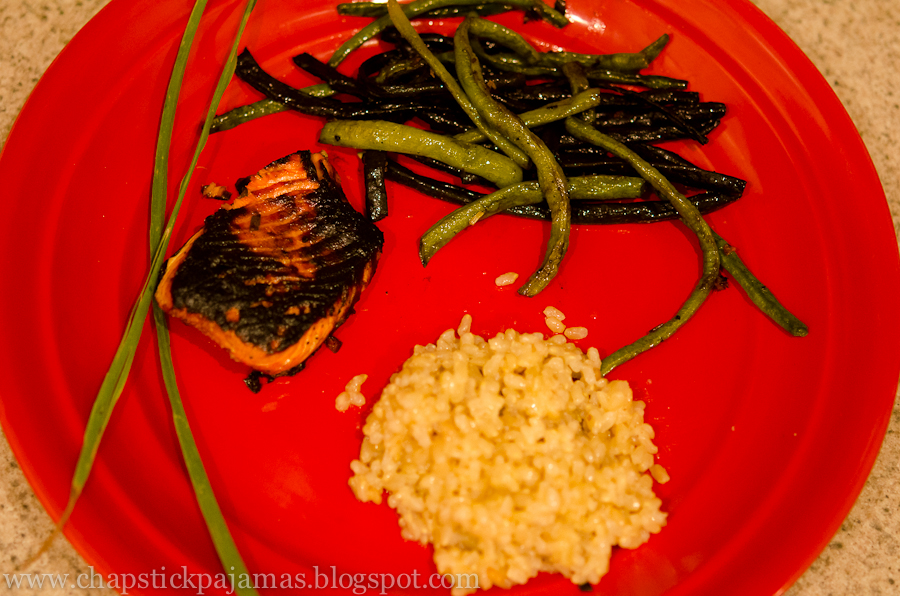
Thai salmon (baked)

With my remaining salmon, I proceeded with my cooked dish. But yet again, it calls for marination. Luckily, the minimum marinating time is 10 minutes. 

I combined many lovely ingredients in a bowl, such as soy sauce, rice vinegar, mirin, jalapeno, fish sauce, garlic, honey, and lemongrass. I had to substitute a jalapeno for a Thai chili; I actually have a Thai chili plant but it's not fruiting yet. 
I also have lemongrass growing, but it wasn't exactly mature enough yet for me to yank up a bunch of it; I still pulled two leaves off and their crinkly roots smelled incredibly fragrant, and it totally did the trick.

I cooked the sauce on medium-high for about 7 minutes until it got pretty thick, then stuck it in the fridge to cool off a bit.

Lastly, I coated each side of my small fillets with the thick, gooey sauce and put it in the fridge.

Then I had to think about what to serve it with. I have these really awesome beans I got from the farmers market last week...I don't remember exactly what they are, but they're Asian. So I figured they would get along with my Thai salmon quite nicely.


I steamed it and then let it bathe in the oils and flavors of the salmon after I had fried it in a skillet.


I decided I was in the mood for some grains, so I poured coconut milk, water, and lime juice into a pot with about 1/2 cup of brown rice; I added a touch of salt and honey to give it some nice contrasting flavors, and boiled the heck out of it for 40 minutes. Damn you brown rice...why do you have to be so good but take so long?


So here it is. It was AMAZING. The flavors were outstanding. Just incredible. This is one of the best fish dishes I've ever made. Yeehaw!
The end.